Tourist destination

But Thap Pagoda
Bac Ninh is famous for its ancient sacred temples. One of them certainly cannot help but mention But Thap Pagoda. The pagoda has an extremely unique architecture and will be an ideal destination if tourists want to find a simple place. The pagoda is located right next to the Duong River, around the pagoda there is a winding river, creating an extremely poetic scene. The pagoda also has another name: Ninh Phuc Tu, located in Dinh To commune, Thuan Thanh district, Bac Ninh province. This is one of the few temples that still retains its original beauty. But Thap Pagoda is an ancient pagoda with extremely unique architecture in Bac Ninh. Ninh Phuc pagoda was built around the 17th century during the Later Le dynasty. The pagoda's construction architecture is in the "Foreign Internal" style. Although it has gone through hundreds of years of history, the pagoda still retains its ancient beauty. This is also one of the National historical sites that tourists should visit. In particular, you will not want to miss the opportunity to participate in the But Thap Pagoda festival. The main architectural structure of the pagoda faces south. According to Buddhism, this is the direction to express wisdom. The pagoda was built according to a strictly symmetrical layout. The central area of the tower is built with 8 folds of houses running parallel to an axis along the Shinto path model. The outermost area of the pen tower is Tam Quan, then the Bell Tower and other worship buildings. On the left side of the pagoda is the place to worship Zhet Tuyet and Bao Nghiem stone tower with 8 sides and 5 floors up to 13m high. Along both sides of Tien Duong building are two stele houses and two corridors built along the length of the temple. If you have the opportunity to attend the But Thap Pagoda festival, visitors should take the time to visit some of the recommended locations. Guaranteed you will have a complete spiritual trip. First is the Avalokiteshvara Buddha Statue. The Buddha statue is one of four national treasures recognized by the State located at the temple. In addition to the Avalokiteshvara Buddha statue, visitors will have the opportunity to admire: The Three World Buddha Statues, along with the Incense Burner and the Nine Product Lotus Palace. One of the places of special interest to many tourists in But Thap Pagoda is is the thousand-armed, thousand-eyed Guan Yin statue. This statue is very old and was confirmed to have been sculpted in 1656. The statue is 2.1m wide, 3.7m high, and 1.15m thick. It is called the thousand-armed-thousand-eyes Buddha statue because the Guan Yin statue has a total of 11 heads with 952 short arms and 42 long arms. This is truly a unique work of art imbued with Buddhist meaning. Second is Bao Nghiem Tower. A place that tourists must definitely visit when visiting But Thap Pagoda is Bao Nghiem Tower. The tower is located right inside the temple grounds. This is the place to worship Venerable Chuyet Chuyet. Bao Nghiem Tower was built in 1647 during the reign of King Le Chan Tong. This is also a project recognized as having a long history. The main door of the tower was also built facing the south with the words "Bao Nghiem Thap" right on the body of the building. The tower has a relatively unique architecture, gradually building from low to high. Viewed from above, Bao Nghiem Tower looks like a giant pen in the blue sky.
Bac Ninh
5716 view


Dau Pagoda
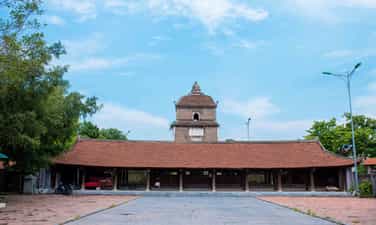
Dau Pagoda is also known as Ca Pagoda, Co Chau Tu, Dien Ung Tu, Phap Van Tu. Dau Pagoda is located in Thanh Khuong commune, Thuan Thanh district. Dau Pagoda is a cultural and religious work with extremely great and profound historical cultural value, including historical cultural value, religious beliefs and artistic architecture. In 2013, Dau Pagoda was recognized as a special National Monument. The process of formation and existence of Dau Pagoda is closely linked to the development history of our country. Together with a number of neighboring pagodas, Dau Pagoda creates the largest Buddhist center in Vietnam and the region. This is a Buddhist center that was formed earlier than the two famous Buddhist centers of China during the Han Dynasty, Pengcheng and Luoyang. Many famous ancient masters practiced and lived at Dau Pagoda such as: Mau Bac in the 2nd century, Khuong Tang Hoi, Chi Cuong Luong in the 3rd century and Buddhist monk Ty Ni Da Luu Chi in the 6th century. Dau Pagoda is also the Ca Pagoda in the system of pagodas worshiping Tu Phap, Dau Pagoda worships the God of Clouds (Phap Van), Thanh Dao Pagoda worships the Rain God (Phap Vu), Phi Tuong Pagoda worships the Thunder God (Phap Loi), and Phuong Quan Pagoda Worshiping the natural forces of the wet rice farming population is also an expression of Mother Goddess worship, a purely Vietnamese indigenous religion. The pagoda also worships "Duc Thanh Quang" - the symbol of the god SiVa in Hinduism. Thus, Dau Pagoda has typically integrated and improved indigenous beliefs and religions with major religions in the region but still retains a strong national identity. The Strawberry Festival is held on the 8th day of the 4th lunar month every year. This is a major festival of the ancient Mulberry district with many unique traditional cultural features still maintained. Over a long history, Dau Pagoda has undergone many restorations and embellishments. Overhauling all construction items, repairing Hoa Phong tower, painting the statue system, restoring the Three Entrances, clearing the ground in front of the pagoda to embank the lake, and building walls to protect the monument. Dau Pagoda includes the following construction items: Front room, Hoa Phong tower, Tien Duong, Ta Vu - Huu Vu houses, Tam Bao, Hau Duong, corridors and auxiliary works. The front house consists of 7 rooms, 2 wings, inside there are a number of tables and chairs for guests to prepare to worship before entering to worship Buddha. The most prominent of the pagoda's buildings is the Hoa Phong tower. According to ancient bibliographies, during the Tran Dynasty, Poinsettia Mac Dinh Chi restored Dau Pagoda and built a 9-storey tower. But the architecture of the tower is still from the Le Trung Hung period. The tower is built of old burnt bricks, with 3 floors, 15m high. Outside the tower there is a statue of a sheep made of stone 1.33 m long and 0.8 m high. In the tower there are 4 statues of Thien Vuong - 4 legendary gods who govern the 4 directions of heaven. In the tower, hang a bronze bell cast in 1793 and a gong cast in 1817. Tien Duong House consists of 7 rooms and 2 wings. In front of the house are three steps running through the 5 middle spaces. In the middle space, there are two stone steps carved with dragons, bearing the artistic style of the Tran Dynasty. At the front hall, there are altars to worship Ho Dharma, Monsignor, Duc Thanh Hien, and Bat Bo Vajra. The statue of Phap Van is worshiped in the Upper Palace. This is one of four statues in the Four Dharma statue system in Dau - Luy Lau region recognized as a National Treasure. The statue of Phap Van is majestic, quiet, bronze-colored, nearly 2 meters high. The statue has a beautiful face with a big mole in the middle of the forehead, reminiscent of Indian dancers and the homeland of Tay Truc. The area connecting the Front Room and the Back Hall is the place to worship the Eighteen Arhats (18 enlightened disciples of Buddha who have cultivated to the Arhat realm). In addition, statues of Bodhisattva, Tam The, Monsignor, and Saint Monk are placed in the back of the hall. Through many changes, ups and downs of history. Dau Pagoda is a destination for Buddhists across the country. Tourists coming to Dau Pagoda return to Buddhism and admire the beauty and values that the pagoda brings. As its simple name suggests, Dau Pagoda is the oldest pagoda in Kinh Bac.
Bac Ninh
5841 view


Dinh Dinh Bang
Referring to Bac Ninh is not only mentioning folk songs that go deep into the subconscious of Kinh Bac people, but also mentioning a long-standing ancient land with unique cultural traditions. That culture is expressed through craft villages such as Dong Ho Painting, Bronze Casting Craft Village, Phu Lang Pottery... or spiritual places such as Do Temple, Dau Pagoda, Phat Tich Pagoda, But Thap Pagoda. Dinh Bang village communal house is a communal house located in Dinh Bang village (formerly Co Phap village) - hometown of Ly Cong Uan (also known as Ly Thai To), who founded the Ly dynasty and founded the capital Thang Long (in 1010). This is considered the most ancient and famous communal house in Kinh Bac. Since ancient times, Northern folk have had a saying: "First is Dong Khang communal house/ Second is Bang communal house, glorious Diem communal house" which is also to praise the architectural beauty and historical and cultural value that Bang communal house brings. again. Dinh Bang communal house was built in 1700. The founder was mandarin Nguyen Thac Luong (formerly the governor of Thanh Hoa) and his wife Nguyen Thi Nguyen. My grandparents bought ironwood, a precious and durable wood, and brought it as offerings to build the communal house. This project took nearly 40 years to build. Like many Vietnamese village communal houses built in the late 17th and early 18th centuries, Bang communal house has majestic architecture, in harmony with Vietnamese nature. Originally there were three gates, the middle door was built with two tall lantern-style brick pillars, on both sides there were rolling archways with fake roofs, behind was a large yard, on both sides were two rows of left and right vu. The communal house has a long, high roof, sharply curved ends, and is covered with thick, wide, square-tiled tiles. The corner of the roof, called the "sword boat", is curved upside down. Dinh Bang village communal house includes a massive communal house connected to the rear harem in a mallet-shaped plan. The most massive and important building is the Dai Dinh (Bai Duong). The communal house is rectangular, 20 m long and 14 m wide. The communal house has a structure of truss and beams, consisting of seven rooms and two wings (side rooms). The interior of the communal house is decorated with many rich themes such as the four precious animals, the four sacred animals, swords, and wine gourds. Sculpture art shows the trend of the late 17th and early 18th centuries, which was royal art overwhelming folk art.
Bac Ninh
5520 view


Lim Association
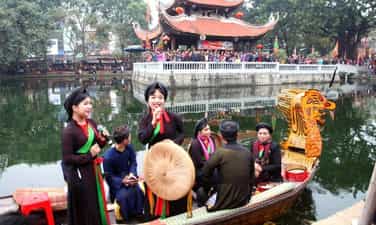
Every spring, everyone gets excited and looks forward to the festivals that take place every year in many places. And one of the famous traditional festivals that everyone knows is Bac Ninh Lim Festival. Lim Festival is a festival of ancient villages located around Lim Mountain and the banks of Tieu Tuong River. It is a major festival of the region, expressing in the deepest way the culture, art and spiritual beliefs of the people of Kinh Bac. The history of Lim Hoi is passed down orally in many different versions. There is a belief that: Lim Festival originated from pagoda festivals and singing festivals, related to the singing of Truong Chi, whose ancient mark left behind is the trace of the Tieu Tuong river, which is quite clear in the villages of Lim region. This hypothesis is based on the legend of Truong Chi - My Nuong. The Lim Association has a very long history, and has grown to the size of a total association (General Noi Due). Based on the traditional festivals of the villages in Noi Due district (including 6 communes and wards: Noi Due (Dinh Ca and Lo Bao), Noi Due Khanh, Noi Due Nam, Lung Giang, Xuan O and Tien communal house singing ward Du (later Due Dong) with many processions, sacrifices and extremely rich folk art activities, such as: drum singing, cheo singing, ca tru singing, tuong singing and quan ho singing..., district officials Duke Do Nguyen Thuy - from Dinh Ca village, Noi Due, Kinh Bac region donated many fields and money to General Noi Due to restore communal houses and pagodas, expand festivals, and preserve fine customs and traditions. He stipulated Naturalization ceremony to pray for blessings takes place in January every year, according to the tradition of "spring and autumn two seasons". Thus, Duke Do Nguyen Thuy is the person who has contributed to the development of the festival of worshiping gods and praying for blessings of villages in the Lim region. Organized the Noi Due festival in the fall, August, with general regulations. At the same time, he was also the one who initially built the customs of the festival in the spring, January. 40 years later, in the second half of the 18th century, the same Dinh Ca villager, general Nguyen Dinh Dien, continued to develop and innovate the Lim festival. He provided fields and money for the generals to move the generals' association from the fall of August to the spring of January. He also spent money to buy half of Hong Van Mountain (ie Lim Mountain) to build his tomb on the top of the mountain. The Lim Association was maintained throughout the 19th century and the first half of the 20th century. During the resistance war against the French colonialists and the Americans to save the country, the Lim Association was not opened for many decades until the years after the reform. Today, the festival is opened on the 13th day of the first lunar month every year. Due to its expansion in both area and scale, it must be said that the Lim festival is a large festival and is organized elaborately and majestically. The festival space takes Lim hill as the center, has Lim pagoda - a place to worship Mr. Hieu Trung Hau - the founder of Quan Ho singing custom and takes place in 3 surrounding localities: Noi Due commune, Lien Bao commune and town. Lim. Lim Festival usually lasts for about 3 days (from the 12th to 14th of the first lunar month every year), of which the 13th day is the main festival with many focused activities. That's why tourists also focus on traveling to Bac Ninh on the 13th to be present at the Lim festival itself. Lim Festival begins with a procession. The members of the procession are people dressed in ancient costumes with colorful colors. On the main holiday (January 13) with rituals of procession and worship to the village's tutelary gods, famous goddesses of the homeland at Co Lung temple, Hong Van mausoleum, Duke Do Nguyen Thuy mausoleum, offering incense Worshiping Buddha and midwife A at Hong An Pagoda. In addition to the ceremony, the festival also has many folk games such as martial arts, wrestling, chess, fairy swing, weaving competition, rice cooking... and the most special part is the festival singing. The ancient tradition left behind a special attractive and passionate custom that only Bac Ninh has, which is the cultural activities of singing Quan Ho folk songs - a type of folk song that has become a common cultural asset of the people. clan. Singing Quan Ho folk songs takes place from January 12 at Lim (Hong An Pagoda yard and Quan Ho camps) and throughout pagodas and communal houses. The Bac Ninh Quan Ho singing festival takes place anywhere: in the house, on the communal house yard, in front of the pagoda or floating on basket boats in the middle of ponds and lakes - ancient vestiges of the Tieu Tuong stream that once echoed with singing. Truong Chi captivated the beautiful My Nuong. As long as there are brothers and sisters there, He immediately wore a turban and a white shirt, while she wore a long-sleeved shirt and basket hat with straps to meet again, meet and welcome each other cordially, warmly, delicately and elegantly according to the ways of Quan Ho singers. with folk songs that have reached a high artistic level, a smooth and passionate combination of poetry and music to express pure love, wholeheartedly for the other person, faithfully looking forward to the hardships of love. love the couple. If you have the opportunity to enjoy the songs sung by the artists of Kinh Bac land, it will surely be an experience that you will "remember forever and never forget".
Bac Ninh
5805 view


Do Temple
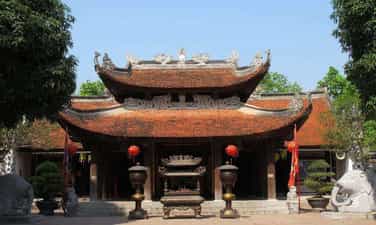
Located in Dinh Bang village, Dinh Bang commune, Tu Son town, Bac Ninh province, Do temple was built in the 11th century and is also known as Co Phap Dien or Ly Bat De temple. The temple is the place to worship 8 Ly Dynasty kings: Ly Thai To, Ly Thai Tong, Ly Thanh Tong, Ly Nhan Tong, Ly Than Tong, Ly Anh Tong, Ly Cao Tong and Ly Hue Tong. With an area of more than 31,000 square meters, Do Temple has 21 large and small projects divided into inner city and suburban areas, with the main temple at the center. Coming here, you will be amazed by a vast landscape with majestic palaces, majestic harems, relaxing water pavilions and quiet epitaphs. In ancient temples, the scent of incense seems to spread throughout the space and makes us think of a heroic and heroic dynasty. Over many dynasties, the temple was repaired and expanded many times. Not only possessing unique cultural and historical values, Do Temple also possesses unique folk royal architecture in an overall charming landscape and harmony with nature. This is also a typical architectural work with the art of carving stone, wood, and statues with many delicate and elaborate carvings. The uniqueness of the architecture at Do Temple does not have high artistic value and partly represents the historical and cultural value of the Ly Dynasty in particular and the nation's historical culture in general. Every year, the Do Temple Festival is held on the 14th, 15th and 16th of the third lunar month to commemorate the day Ly Cong Uan ascended the throne and issued the "Edict to move the capital". This is a long-standing traditional ceremony and has become a custom deeply rooted in the cultural and spiritual life of the people here. The festival attracts many tourists to offer incense and pay respect to the Ly Dynasty kings.
Bac Ninh
5784 view


Phat Tich Temple
Phat Tich Pagoda is one of the pagodas with a long history bearing the mark of the Ly Dynasty. These precious cultural heritages are a living, humane source of documents in the journey to find the nation's roots. So if you are interested in Buddhist beliefs and traditional historical values, Phat Tich Pagoda will be a place not to be missed. The pagoda is located in Phat Tich commune, this is the place where the meeting between ancient Vietnamese folk beliefs and Buddhism took place. That harmonious combination formed the first Buddhist center in our country. With its great historical and cultural values, Phat Tich Pagoda attracts many tourists to study and sightsee every year. According to historical records, the pagoda was built in the fourth year of Thai Binh, i.e. 1057. The purpose of building the pagoda was to meet the needs of spiritual beliefs and convey the faith of a large number of people. Initially, the pagoda was built with many horizontal and vertical buildings. Next, King Ly Thanh Tong built another Linh Quang tower here in 1066. Later, when the tower collapsed, it was revealed that inside there was an Amitabha Buddha statue made from monolithic green stone plated with gold. The villagers changed its name to Phat Tich and moved and lived on the mountainside in front of the magic of the Buddha statue. Until now, although it has undergone many changes over time, the temple still retains many ancient and quiet features. The pagoda is designed in the style of Internal Cong and Foreign Affairs. The yard of Phat Tich Pagoda is the first foundation level. This place is associated with the garden of the blooming peony legend passed down in the famous legend "Tu Thuc met the fairy". The second level of the pagoda is where ancient architecture is located, but over time it can no longer be seen today. The third platform is at the highest position, with Long Tri, a rectangular pond that is now dry. The unique feature of the pagoda is the green stone statue of Amitabha Buddha sitting on a lotus flower, 1.87 m high. This is one of the unique sculptures of top-notch sculpting techniques. In addition, at Phat Tich Pagoda there is also a statue of a bird playing a drum. This statue represents freedom from worldliness and the desire to reach people's dreams. Right in front of the pagoda there is a row of 10 animals: buffalo, rhinoceros, elephant, horse... of large size. All are made from stone, demonstrating the talent of Ly Dynasty artisans. Today, the pagoda has a total of 7 front halls used to welcome guests from near and far. The pagoda has 5 compartments worshiping Buddha, Amitabha and the three generations. In addition, there are 7 Mother Church rooms and 8 Patriarch's houses. The path to the pagoda has three tarpaulin steps into the mountainside with a vertical stone embankment like a 58m long wall. The three platform steps are 3–5m high and in the middle of the wall is a 5m wide stone walkway with up to 80 steps. You can visit Phat Tich Pagoda at any time of the year but the best time is January. At this time, the weather is cool and flowers and grass are growing, so it is very suitable to visit the temple. In addition, the Peony Festival at Phat Tich Pagoda is also one of the earliest and largest festivals in Bac Ninh. The festival is associated with the touching love story of Tu Thuc meeting a fairy. Phat Tich Pagoda Festival usually takes place for three days, from the 3rd to the 5th day of the Lunar New Year every year. The main day of the festival is the 4th. From the 3rd day, many tourists flock to the temple to worship Buddha, pray for luck and peace. Tens of thousands of tourists were eagerly present here to attend the festival. A small note is that when visiting the temple, tourists should dress politely and discreetly to show respect for Buddhism. Phat Tich Pagoda is truly a place that preserves the nation's thousands of years of historical values. Tourists come here not only to make a pilgrimage to worship Buddha but also to contemplate the ancient values of the nation.
Bac Ninh
6167 view


Xuong Giang ancient citadel
Xuong Giang ancient citadel, located exactly in Xuong Giang ward, right in the center of Bac Giang city, Bac Giang province. When talking about Bac Giang, people think of a land of outstanding people, with a rich history of building and defending the country, marking resounding victories. Among them, it is impossible not to mention the magnificent place Chi Lang - Xuong Giang. Since then, Xuong Giang Citadel has become a spiritual and tourist destination, honored as a special historical relic. National level, an interesting destination when visiting Bac Giang. Xuong Giang is the name of the ancient citadel built by the Ming army in the 15th century (1407). The citadel was built of soil. According to the remains excavated, the citadel was built in a rectangular shape, along the East - West direction with a measured length of 600m, width measured in the North - West direction. South is 450m and with a total area of 27ha. Surrounding Xuong Giang Ancient Citadel is a thick and sturdy high earthen wall, with four corners surrounded by a fortress and a wide moat, with four open doors, the main door facing west. According to the actual survey and relic records left behind by Xuong Giang Ancient Citadel, there are not many vestiges of the ancient citadel left, in which the citadel wall is about 3-4m higher than the surrounding ground, the base is 25m wide and the front is 16-20m wide. The 4 corners of Xuong Giang ancient citadel have 4 fortresses 4 meters higher than the citadel surface, protruding completely outside and outside the citadel is a surrounding trench system running around to ensure the ancient military strategy. According to historical books, Xuong Giang Citadel is a place associated with the Xuong Giang victory of the famous Dai Viet army and people led by Le Loi. Here, the army defeated 100,000 Ming invaders in a battle lasting nearly a month stretching along the areas of Lang Son and Bac Giang today with four major victories: October 10: Defeated the enemy and finished off Crown Prince Lieu Thang at Chi Lang gate; The battle on October 15 defeated the military service in the Can Tram area, today Huong Son - Lang Giang, causing enemy general Bao Dinh Ba Luong Minh to commit suicide; The battle of Ho Cat on October 18, located in the area of Voi, Xuong Lam, Phi Mo - Lang Giang today, caused Minister Ly Khanh to commit suicide. Especially the battle of Xuong Giang on November 3, 1427, on Xuong Giang field (today in Tan Dinh, Xuan Huong, My Thai communes, Lang Giang district and Tho Xuong, Bac Giang city), our army won after 10 days of siege. In that battle, the insurgent army defeated up to 70,000 enemy troops, led by two talented generals Thoi Tu and Hoang Phuc, forcing the Ming army at that time stationed in Dong Do - Hanoi to withdraw to the country. Last year's victory of the Lam Son insurgent army led by the talented general Tran Nguyen Han to take over Xuong Giang citadel and destroy Lieu Thang's powerful army made an important contribution to drawing a historic victory from which to continue. The foundation to help our country overthrow the brutal rule of the Ming Dynasty that lasted for 20 years, deciding our country's independence in the 15th century. At that time, Xuong Giang Citadel was considered the center of the battle and was continuously a historical witness to many important historical events of the homeland at that time, especially the famous uprising with its leadership. The leadership of general Nguyen Huu Cau, also known as District He, occurred in the second half of the 18th century. As a historical witness of many illustrious historical events, Xuong Giang Ancient Citadel is still chosen every year by Bac Giang province as a festival venue, usually on January 6-7. During the festival, there are many unique rituals and fun games to commemorate the historic victory of the Lam Son insurgent army at Xuong Giang Citadel that year. Before the opening day of the festival, usually on the evening of January 5, young people here organize campfires and at communal houses, pagodas and cultural houses, they will light torches all night to wait until the fifth watch to line up. party, banging gongs and dancing drums and bringing them back to the gathering place to open the festival. Therefore, every year in the early morning of the 6th day of the first lunar month, we will enjoy the wonderful festive atmosphere with groups of people from the wards and communes, raising flags, beating drums, and all kinds of floats and pants. Brightly dressed, one after another poured from the streets towards the festival center and started the biggest festival of the year here. With that historical significance, on January 22, 2009, the Ministry of Culture, Sports and Tourism issued a decision to classify Xuong Giang Citadel as a national historical relic, with 14 relic sites: northeast, east gate, north gate, southwest gate, south gate, central area, traces of the citadel, the section of Xuong Giang river flowing through the citadel; Archaeological excavation sites No. 2, 3, Phu well, Thanh temple and 2 points outside the protected area: southeast gate, west gate.
Bac Ninh
5566 view


Cam Son Lake
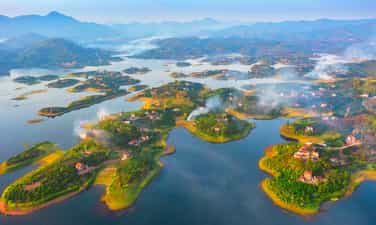
Cam Son Lake is located in Son Hai commune, Luc Ngan district, Bac Giang province, and is considered the fourth largest irrigation project in the country. The main task of the lake is to provide water for agricultural production. Although it has an average area of 2,600 hectares, in the summer and during times of heavy rain, the lake surface can expand to more than 3,000 hectares. Cam Son Lake is surrounded by majestic high mountains and lush green forests, creating a enchanting natural space. To get to Cam Son Lake, you can drive from the center of Hanoi along a road about 100km long. On the way, you will have to pass Long Bien bridge and Tu Son town, then go to Bac Ninh and drive about 22km to Bac Giang. Here, you will continue to follow Highway 31 to Chu town (Luc Ngan) and find a left turn to go to Khuon Than lake (provincial road 289). When you arrive at Kien Thanh commune committee, you are only about 15km away from Cam Son Lake. However, because the road is quite far and includes many different sections, to ensure the safety of your trip, you should go with a large group of people and rest periodically along the way. In addition, you can also ask local people for more specific directions to avoid getting lost and wasting time. Cam Son Lake is a suitable tourist destination to visit at any time of the year. However, according to the experience of those who have been here, summer is the best time to experience the open space and enjoy the beautiful scenery of the lake. You can camp with friends or experience swimming in the lake here. In addition, autumn is also a great time to travel to Cam Son Lake, at this time the climate is cool and the trees begin to change leaves, creating a romantic natural space. If you want to experience the bright red lychee crop of Luc Ngan hills, you can plan to come here around June or July. This is also the time to immerse yourself in the harvest atmosphere of the residents. local. Cam Son Lake is like a charming natural painting of mountains and water, with the special feature of this place being that the lake shore is surrounded by overlapping mountains. People travel mainly by boat, preserving many traditional cultural features. When coming here, visitors will admire the wild beauty of high mountains and rows of green trees creating shadows on the fresh lake surface. In addition, hundreds of large and small islands undulating in the middle of the lake surface enhance the feeling like you are living in a miniature version of Ha Long, in Bac Giang. You may not know, the romance and poetic nature here once inspired musician Pho Duc Phuong to create the song "Lake on the Mountain", which has become a famous work to this day. In addition, you can travel with your loved ones to small islands and admire the majestic clouds and mountains at Cam Son Lake by motorboat. In addition to admiring the beautiful nature, visitors can also participate in many interesting activities at Cam Son Lake such as boating, climbing, fishing,... This will definitely make your trip more enjoyable. becomes full of excitement and meaning. Not only that, Cam Son Lake tourist area is also a "hot" destination in Bac Giang, attracting many young tourists to come here for camping and picnics. After exploring the island on the boat, you can stop by the fishing village to buy specialty products such as shrimp and fresh fish. In addition, you can visit the surrounding houses to buy hill chicken and rent the homeowner's kitchen to cook the typical dishes of this land yourself. This is truly a great experience to learn about local culture, customs and feel the warmth and friendliness of the people here.
Bac Ninh
7210 view


Duc La Pagoda
Duc La Pagoda (also known as Vinh Nghiem Pagoda) is located on a low hill in Duc La Pine, Tri Yen Commune, Yen Dung District, Bac Giang Province. Duc La Pagoda is located about 18 km from the city center. Maybe that's why this place is free from the hustle and bustle of the city. The pagoda was built from the beginning of the reign of Ly Thai To (1010-1028) until the reign of King Tran Thanh Tong (1258-1278). The pagoda was a place where many high-ranking monks practiced. Therefore, the pagoda has been renovated to be more magnificent and splendid. The pagoda is also the place where King Tran Nhan Tong came to receive ordination and founded the Vietnamese Zen Buddhist sect. At Duc La Pagoda, King Tran Nhan Tong, Phap Loa and Huyen Quang created the Truc Lam Tam To of the Truc Lam Zen sect. Duc La Pagoda stands out with its charming and poetic natural landscape. The pagoda is located on a low hill, at the confluence of Luc Nam and Thuong rivers. Surrounding the pagoda is Co Tien Mountain. A great location, meeting the mountains and rivers. Not noisy or bustling, standing here, people seem to be immersed in the vastness of heaven and earth. Duc La Pagoda is located on a large campus with an area of about 10,000 square meters. The beginning is Tam Quan gate and then Tien Duong. Entering the temple yard, the old imprints that are still preserved appear right before your eyes. Among them, the large 6-sided stele of Hoang Dinh year is considered the oldest. Duc La Pagoda has a unique architectural style, preserved for thousands of years. The pagoda has a structure with 4 blocks: the pagoda is shaped like the letter "cong", on both sides there are rows of Ta vu and Huu vu. The rows in the pagoda are spacious with 18 compartments. Duc La Pagoda is also known for its sophisticated and artistic sculpture values. Shown most clearly through the system of Buddha statues arranged in 3 main blocks: Three Jewels, First Patriarch's House and Second Patriarch's House. Besides, the pagoda also retains many valuable relics. Notable to mention are the horizontal panels - couplets and the epitaph system with 8 panels recording the historical and development process of Vinh Nghiem Buddhist Center.
Bac Ninh
7803 view


Suoi Mo tourist area
Suoi Mo eco-tourism area is located on the spiritual route from Bac Giang city to Thanh Son town (Son Dong) connecting with many attractive tourist areas and destinations such as: Vinh Nghiem Pagoda (Yen Dung); spiritual - ecological tourism area of West Yen Tu, Khe Ro (Son Dong), and adjacent to Quang Ninh and Hai Duong provinces, becoming a tourist destination connecting transit with tourist destinations in the relic complex - scenic spots in the East and West of Yen Tu, along with Con Son - Kiep Bac relics and other tourist attractions of the 3 provinces. Suoi Mo eco-tourism area has historical, cultural and religious value, including a system of 3 main temples: Lower - Middle - Upper worshiping the Holy Mother of the Upper Thousand Princess Que Mi Nuong, daughter of the second Hung King. IX - the person who publicly opened the fat abyss, brought water to the fields, and taught people how to grow crops and raise livestock. Suoi Mo Temple with its ancient features and historical cultural values preserved here was recognized as a National Historical Site in 1988. Suoi Mo Temple Festival takes place every year on the 30th of January. The 3rd and 1st and 2nd days of the 4th lunar month are to pray for good harvests and are also an opportunity for people to express their gratitude to Princess Que My Nuong, attracting thousands of tourists from all over to pray for blessings and fortune. .. The festival imbued with national identity was recognized by the Ministry of Culture, Sports and Tourism as a national intangible cultural heritage in 2015. At the same time, Suoi Mo Ecotourism Area also has relics Other nearby areas such as: Tran Temple, Boy Lech Temple, Co Be Xanh Temple, Quan Temple...; Historical relics of a heroic time of the nation such as Quan Ngua Beach, Ba Dinh Bay Platform area during the Tran Dynasty...; Relics bearing the mark of Buddhism in Truc Lam Yen Tu such as: Ho Bac Pagoda, Hon Egg Pagoda... create Suoi Mo cultural and spiritual tourism complex. One of the things that any tourist who has ever been to Suoi Mo cannot forget is the ecological beauty of the mountains, forests, streams, and waterfalls here. Stretching over an area of thousands of hectares, Suoi Mo's primary forest system is extremely rich and diverse, creating a condition for sustainable development of eco-tourism - resort. Suoi Mo has two main waterfall systems: Suoi Mo waterfall and Thum Thum waterfall with majestic and poetic beauty. Each waterfall system has many majestic waterfalls, each step has its own beauty, and especially at the foot of these waterfalls there are extremely interesting natural baths. Coming to Suoi Mo on hot summer afternoons, visitors will be able to soak in the cool water and then let the water from above pour down caressingly all over their bodies like a physical therapy to help dispel the pain. stress and fatigue after hard working days or choose your own space on chairs and stone beds to rest and feel the beauty of Suoi Mo mountains and forests. In Suoi Mo Ecotourism Area, there is also Suoi Mo reservoir with a total water surface area of more than 30 hectares, around the lake are flat green lawns suitable for various types of tourism such as: camping picnics, fishing, boating... At the same time, with a system of primeval forests, Suoi Mo rocky plateau is an attractive destination for young people who are passionate about backpacking and mountain climbing to explore the beauty of nature here. Suoi Mo is identified as an important highlight in tourism development of Bac Giang province, always receiving attention for construction investment. Recently, the infrastructure of Suoi Mo Ecotourism Area has gradually been completed. Many important investment items with a total amount of hundreds of billions of VND such as: Suoi Mo lake project, Suoi Mo landscape protection forest, tourist area infrastructure investment project; upgrading and repairing Ha Temple, Van Theater and campus; Tran Temple suspension bridge; tourist route construction around Suoi Mo lake; The work of repairing and embellishing the Trung Temple relic area...
Bac Ninh
7938 view


